Integrating Environmental, Social, and Governance principles into our business
Design & Value Engineering
Our Commitment to ESG
At LRC Group, we recognize that our success as a pan-European real estate investment and fund manager is intrinsically linked to the well-being of the environment, the communities we operate in, and the governance practices we uphold.
Further, we understand the important role that the real estate sector can play in tackling key sustainability issues such as climate change, biodiversity loss and social inequalities, and we are committed to advancing the transition towards a more sustainable built environment.
We seek to align with our stakeholders’ expectations by incorporating ESG matters into our investment decisions. Doing so requires an ESG Framework that integrates responsible investment practices into business operations and asset stewardship.


We believe that integrating Environmental, Social and Governance (ESG) principles into our business is not just a responsibility but a driver of long-term value creation for our stakeholders, and the LRC ESG Framework is designed to respond to that, to support and guide our decision-making processes.
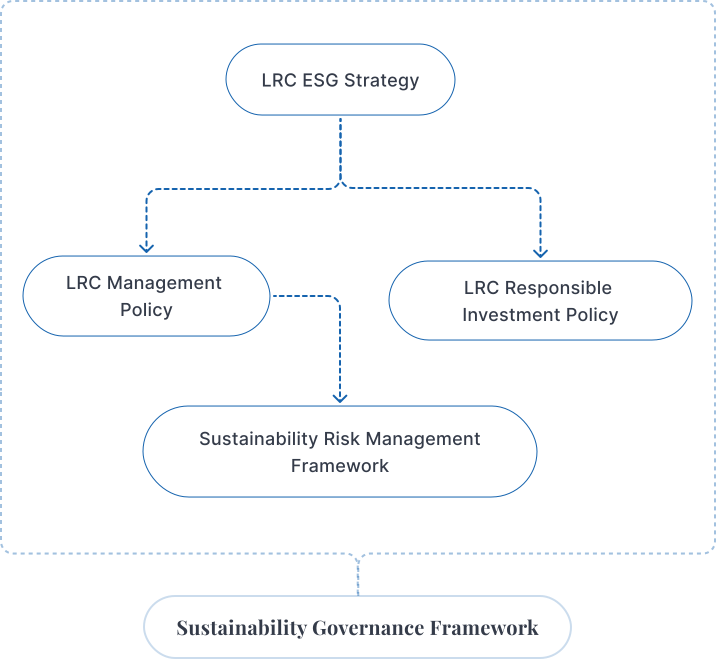
Within our ESG Framework, the Responsible Investment Policy and Risk Management Policy, which includes sustainability risks and mandates the use our Sustainability Risk Management Framework, form key governing documents for operationalising the ESG Strategy. Accountability for implementing these is ensured through the Sustainability Governance framework, led by our management Sustainability Steering Committee, with specific actions assigned to responsible individuals and tracked by LRC leadership.
LRC ESG Strategy
Drives our actions, initiatives and future direction, for both LRC as an organisation and for the assets we manage. Focuses on integrating ESG factors, identified via a 2023 materiality assessment and benchmarking exercise, into an organisational strategy aimed at enhancing portfolio performance.
Responsible Investment (RI) Policy
Reflects our drive to create long-term value for investors and to use our position to affect the environment and society. Our RI Policy outlines the principles and responsible investment practices that we apply across our portfolio. This Responsible Investment approach spans the investment lifecycle.
Risk Management Policy
Includes an outline of key sustainability risks that may affect LRC and our portfolio, and maps where they occur in the investment lifecycle, as well as setting sustainability key risk indicators and corresponding risk mitigation measures. The Policy refers in particular to the standalone Sustainability Risk Management Framework, which is an essential tool for implementing our Risk Management Policy.
Responsible Investment Lifecycle
Our Responsible Investment approach spans the full investment lifecycle, as shown in the flow chart below.
- An initial look into ESG-related risks and opportunities relating to a potential asset
- Assessing ability to support any fund-level ESG strategy
- Deeper dive into an asset's environmental, social and governance performance and strategy
- Enhance understanding of actions required for an asset to align with any fund-level ESG strategy
- Implement actions to improve ESG credentials of an asset
- Ongoing data collection and reporting to inform strategy progress
- Disclosure of appropriate ESG-related information on an asset to ensure full potential is reached
SOCIAL
As residential and commercial property owners and managers, strong stakeholder relationships are key.
Our focus areas include:
- Tenant Experience: Offering high-quality, safe, and flexible spaces tailored to meet the needs of modern tenants.
- Employee Well-Being: Promoting a diverse and inclusive workplace culture where employees can thrive through professional development opportunities and well-being initiatives.
- Affordable Mid-Market Housing Solutions: Contributing to housing solutions that address societal challenges and create accessible living spaces.
- We are committed to ensuring that there is no modern slavery or human trafficking in our supply chains or in any part of our business. We operate a Whistleblowing Policy so that all employees and stakeholders know they can raise concerns without fear of reprisals. LRC has a Modern Slavery Statement, which outlines how we work to mitigate the risk of enabling modern slavery and human trafficking. Our efforts to mitigate this risk are enacted through our recruitment practices, through our Whistleblowing Policy, via our supply chain compliance procedures, in ongoing monitoring and collaboration, and through training of relevant team members.
At LRC Group, we strive to create positive social outcomes by fostering inclusivity, community engagement, and well-being.

At LRC Group, we strive to create positive social outcomes by fostering inclusivity, community engagement, and well-being.
Governance
At LRC Group, we adhere to high standards to ensure long-term trust and integrity.
Our governance efforts include:
- Sustainability Steering Committee: Set up as an integral leadership body to oversee the wider sustainability governance framework.
- Responsible Investment: Integrating ESG considerations into our investment decision-making process.
- Compliance: Upholding compliance with regulation and embedding associated practices throughout our organisation.
- Stakeholder Engagement: Maintaining communication with our investors, tenants, and partners.
Transparency, accountability, and ethical decision-making are the cornerstones of our governance framework.
Transparency, accountability, and ethical decision-making are the cornerstones of our governance framework.
Driving Positive Change Together
To learn more about our ESG strategy and initiatives, or to collaborate with us on creating a positive impact, please contact us.

To learn more about our ESG strategy and initiatives, or to collaborate with us on creating a positive impact, please contact us.
ENVIRONMENT
Our focus areas include:
- Energy Efficiency Improvements: Deploying a targeted transition strategy to enhance the energy performance of assets with an aim to reduce the associated carbon footprint.
- Water Consumption Management: Property refurbishment looks at the potential to retrofit with ‘low-flow’ sanitary fittings and ‘water-saving’ fixtures.
- Biodiversity Enhancement: A strategy to increase the provision of on-site green spaces across our portfolio.
Our Sustainability Risk Management Framework regularly monitors climate-related risks and opportunities, including physical impacts like flooding and heat stress, and transition risks such as energy regulation. We’ve identified potential opportunities to include enhancing asset energy efficiency and investing in on-site renewable energy generation. In addition to continuous monitoring, our due diligence process identifies specific risks and opportunities for an asset, so that we can manage them effectively post-acquisition. Two of our funds target energy efficiency enhancements based on EPC/BER ratings.
To improve transparency, we are calculating our portfolio’s carbon footprint to better understand and target greenhouse gas reduction efforts.
Transparency, accountability, and ethical decision-making are the cornerstones of our governance framework.

Transparency, accountability, and ethical decision-making are the cornerstones of our governance framework.