
Responsible Investment Policy
Responsible Investment Policy
This Responsible Investment Policy forms the cornerstone of the LRC Groups efforts to assimilate sustainability and ESG into the way we do business. We do this by;
- Integrating all relevant ESG factors into our investment processes
- Being ESG proactive by embedding ESG and sustainability considerations across all investment stages in accordance with SFDR RTS (2023/2859), CSRD and ESRS
- Actively engaging with our stakeholders to ensure adherence to our ESG expectations
- Reporting on all ESG matters in compliance with international norms
We are mindful that our investment performance (Financial Materiality) is affected by sustainability factors and also the impact on society (Environmental and Social Materiality) that our investments may cause, both positive and negative – this is commonly referred to as “Double Materiality” considerations.
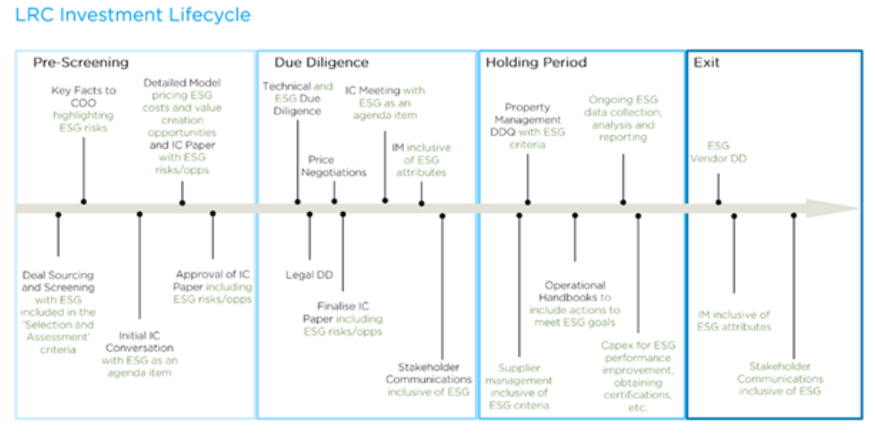
LRC Investment Lifecycle
The LRC Group has, where relevant, integrated ESG throughout the investment lifecycle. This has seen us incorporate ESG specific items at each stage from pre-acquisition (pre-screening & due diligence), through to holding the asset(s) and then to exit. A summary of this lifecycle can be seen below.
LRC ESG Program
Our ESG program is rooted in the principles of monitoring, measuring and managing all of the ESG touchpoints throughout the Group and throughout the investment lifecycle.
- Monitor – have sufficient processes, procedures and systems in place to capture all ESG relevant data
- Measure – having captured the data we then turn it into usable and actionable data
- Manage – this data is then used to manage our ESG commitments
Reporting and transparency
We regularly report on issues of ESG relevance primarily via our website and through fund specific Annual Reports. In addition, if relevant, ESG specific items can be disclosed and reported directly to investors and other stakeholders. The LRC Group supports standardised and integrated reporting, which incorporates material sustainability information with financial information and provides consistent and comparable ESG data. Climate-related disclosures shall align with IFRS S2 (ISSB 2023), which supersedes the Task Force on Climate-related Financial Disclosures (“TCFD”) framework. Our disclosure statement on the consideration of PAI at entity-level can be found on our website. The PAI of our investments is reported annually in this statement. In addition we report on issues of ESG relevance through our website and through the PRI reporting framework. From FY 2025, ESG disclosures will be subject to limited assurance as required under CSRD Article 26.
Data & Technology
Utilising various technology solutions we seek to harness the large volume of ESG related data/dataset to support and optimise our investment approach, due diligence, asset acquisition and asset ownership.
LRC teams and the use of ESG data
We believe that integrating ESG data into the acquisition, portfolio management and asset management processes across our business enables us to generate superior returns and drive positive change at the same time.
- Acquisition team – Considering ESG data in Investment/acquisition research and due diligence allows greater insights into the risks and long-term value of potential acquisitions.
- Portfolio Management team - Considering ESG analysis and insights into portfolio decisions allows portfolio management to better manage potential risks and identify potential opportunities.
- Asset management team - Being active owners of our assets allows us to actively manage potential risks and maximise the benefit of ESG related activities and initiatives.
Good governance
The LRC Group strongly believes in the principles of good governance and, as such, has implemented a full suite of Group policies applicable to all staff and in specific instances to third party suppliers and stakeholders.
We have also developed policies and procedures to ensure that our investments meet our expectations of ESG performance and that ESG/sustainability risk is managed throughout our investment processes and the investment lifecycle.
Our responsible investment approach builds on the PRI guidelines. This is supported by our principal adverse impact (“PAI”) analysis. Principal adverse impact at entity-level is reported annually, in accordance with the EU SFDR requirements. In some instances we may rely on one or more external providers of ESG data (as well as our own internal sources of data). These data providers and other data sources are assessed on an ongoing basis for data quality, timeliness, coverage and other attributes.
The environmental and social impact of our investments is monitored on an ongoing basis, subject to data availability.
Principal Adverse Impacts
Principal Adverse Impacts are negative impacts on sustainability – for example; carbon emissions, waste, fossil fuel exposure, gender diversity, corruption, bribery, etc. The LRC Group strives to manage these impacts through sustainability-relevant policies and procedures.
We identify Principal Adverse Impacts through screening of Environmental and Social materiality. PAI indicators shall follow the updated SFDR RTS Annex I (2023/2859), including expanded social, biodiversity, fossil-fuel exposure, and GHG-intensity indicators. Subject to data availability, our selection of Principal Adverse Impact indicators follows the methodology of selecting the indicators which are relevant to consider based on the nature of our business activities.
Stakeholders
The LRC Group seeks to actively engage with our stakeholders (employees, investors, regulators, suppliers, etc) on all matters relating to ESG, specifically to inform on ESG risk factors and incorporate these items into our investment approach.
We strive to be good neighbours, and to enrich all of the communities in which we live, work and invest.
Conflicts of interest
The LRC Group is aware that potential or actual conflicts of interests may arise as part of our normal day to day activities. As such, the LRC Group has implemented policies to prevent conflicts of interest arising, if at all possible.
In the event that such conflicts cannot be avoided, we will identify, manage and monitor the conflicts and, if appropriate, disclose them to all relevant stakeholders.
Sustainability
The LRC Group is committed to integrating sustainability into all relevant processes in all business areas. We take all relevant environmental, social and governance principles into consideration when evaluating business opportunities and risks. We adhere to the following principles and we expect suppliers and business partners to do so as well;
- Good corporate citizenship
- Ethics, honesty and sincerity
- Rejection of bribery and corruption
- Equal opportunities and diversity
- Employee wellbeing
- Human and Labour rights
- Caring for the environment
LRC will meet human-rights and environmental due-diligence obligations under the EU Corporate Sustainability Due Diligence Directive (2024).
Biodiversity
The LRC Group recognises that nature is being eroded at unprecedented rates, resulting in the irreversible loss of both habitats and plant & animal species. We, therefore, include Biodiversity as one of the risk factors assessed in our pre-acquisition due diligence. Post acquisition, we continually assess how we can enhance and increase biodiversity across the assets we own and manage. Biodiversity-related disclosures shall align with TNFD recommendations where applicable.
Climate change
The LRC Group views climate change as one of the largest threats to life on earth and to the global economy. We are working on an ongoing basis to assess climate change risks in our investments and the impact low-carbon transition. Climate change presents a risk to our investments – in terms of physical risk, policy risk, consumer/tenant risk and transition risk (reducing greenhouse gas emissions).
The LRC Group has a long-term strategic objective to reduce the greenhouse gas emissions impact of our investments and business in line with the IFRS S2 transition plan requirements and science-based net-zero pathways and to ensure that our investment portfolios are resilient to climate-related risks.
The LRC Group aims to comply with international conventions and norms, including, but not limited to the following:
- - United Nations Global Compact
- - OECD Principles of Corporate Governance
- - Universal Declaration of Human Rights
- - UN Guiding Principles on Business and Human Rights
- - Children’s Rights and Business Principles
- - UN Convention on Corruption
Human Rights
The LRC Group is committed to remaining in compliance with all Human Rights legislation in the various jurisdictions in which it operates. We expect all companies within our supply chain to be in similar compliance. Human rights-related issues include but is not limited to human rights abuses, modern slavery, fair living wage, child labour, occupational safety and health and international humanitarian law. LRC will conduct human-rights due diligence in line with CSDDD and national Modern Slavery legislation applicable in the UK and EU.
Green Claims and Marketing
In line with the forthcoming EU Green Claims Directive (expected 2026), all sustainability-related statements or labels used in marketing or investor materials must be substantiated with verifiable evidence. Misleading or exaggerated ESG claims are strictly prohibited.
Data Protection and Record Retention
ESG-related data, investment records, and impact measurement documentation shall be processed in accordance with GDPR (EU 2016/679) and UK GDPR where applicable. Data shall be retained for up to five (5) years following the reporting period, or longer if required by regulatory or assurance obligations. Records will be securely deleted thereafter per the Record Retention & Disposal Policy. Where ESG data includes special category data under GDPR Article 9 (e.g., DEI metrics), processing shall occur only with appropriate safeguards.